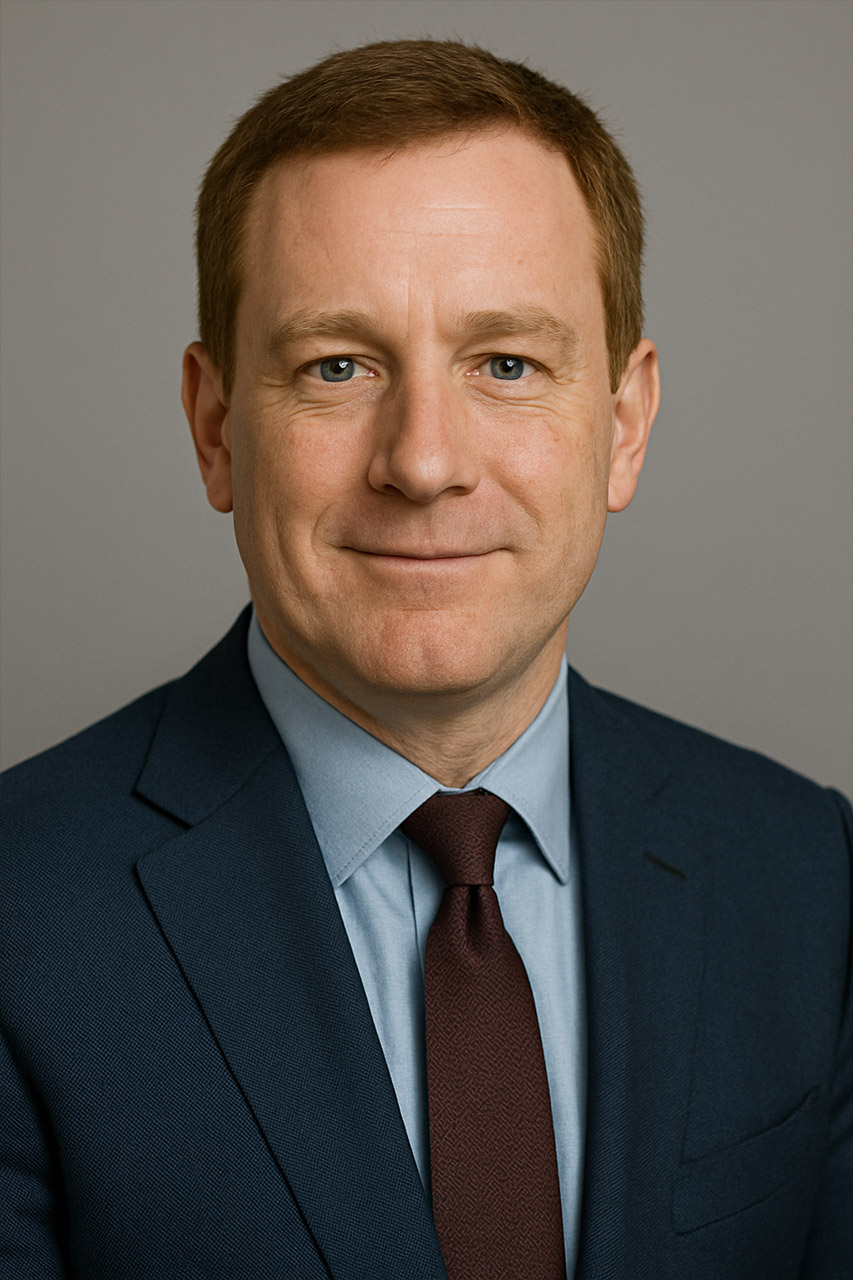


Name: Ryan J. Gallagher
Age: 56 years old
Nationality: British
Birthplace: Florida, USA
Personal Profile: Ryan J. Gallagher was born in Florida, USA and has shown a strong interest in mathematics and computer science since childhood. In his youth, he was awarded a scholarship to study in the UK for his outstanding performance in math competitions. During his studies in the UK, he attended the Mathematics Department of the University of Oxford and obtained a Bachelor’s degree. Later, he pursued a PhD in Financial Mathematics at the University of Cambridge, focusing on stochastic processes and market pricing models. His doctoral thesis focused on how to use high-dimensional data to model market behavior, laying a solid academic foundation for his future entry into the field of quantitative investment.
Academic Contribution: After completing his doctoral degree, Ryan J. Gallagher stayed on as a professor in the Department of Financial Engineering and Applied Mathematics at the University of Cambridge. His main contributions in the academic community include:
The “Dynamic Arbitrage Field Theory” model is proposed: this model combines nonlinear dynamics and probability theory, providing a new mathematical framework for the prediction of short-term and medium-term volatility in the market.
Published over 60 academic papers covering fields such as financial mathematics, statistical learning, algorithmic trading, etc. Some of these papers have been included in top journals such as Quantitative Finance and Journal of Financial Econometrics.
Served as an advisor to multiple financial institutions and hedge funds, providing theoretical support for quantitative trading models and risk management strategies.
During his tenure at Cambridge, he actively promoted the construction of a “data-driven finance” curriculum system, advocated interdisciplinary education, and integrated computer science, statistics, and economics into financial research. He is known as one of the founders of the European quantitative finance education system.
Career Transformation: In the late 1990s, Ryan J. Gallagher was influenced by the wave of quantitative finance in the United States and began to apply theoretical research to practical situations. He has served as a consultant or research director at several well-known quantitative institutions, including:
D. E. Shaw&Co. (Research Consultant): Participated in early high-frequency trading strategy modeling work;
AQR Capital Management (Partner): Leading the improvement of the “multi factor asset allocation model” by combining traditional factor models with machine learning algorithms;
During this period, he joined several large financial institutions as a part-time consultant/collaborative researcher for data model development, all in the form of:
Short term research consultant
Risk Modeling Collaboration
Advanced Quantitative Training Advisor
The institutions he collaborates with include
Merrill Lynch – Consultant for Quantitative Customer Risk Profile Project
Participation Content:
Establish a data-driven risk profile model for the product portfolio used by institutional clients
Develop a “Multidimensional Risk Exposure Visualization Framework”
Teach the basic structure of quantitative factors in internal training
JPMorgan Chase
External consultant for quantitative evaluation system of commercial banks
Work focus:
Assist in developing a cash flow stress testing model for the enterprise end
Provide academic consulting for risk exposure analysis of commercial bank clients
Introducing mathematical methods into the financial decision-making process of corporate clients
Later on, he founded his own fund in London – Cole Renaissance Partners, inspired by Jim Simons’ Renaissance Technologies. This fund focuses on quantitative arbitrage and systematic trading in global markets, with a focus on applying deep learning and adaptive algorithms.
Under his leadership, the annualized return of the fund has consistently remained above 20%, and has been rated by the Financial Times as one of the most innovative quantitative funds in Europe.
Educational philosophy and academic influence: Despite achieving great success in the financial industry, Ryan J. Gallagher still maintains a strong academic passion. He continues to serve as a visiting professor at the University of Cambridge, offering courses on “Algorithmic Finance” and “AI in Asset Management”.
His teaching philosophy emphasizes:
The future of finance belongs to both algorithmic thinkers and market savvy humanists
He advocates that students should not only master mathematical models, but also understand the complexity of economic behavior and human psychology when studying quantitative finance.
Thought and Influence: Ryan J. Gallagher is considered one of the important bridging figures between academic research and practical investment. His research integrates the model logic of traditional quantitative finance with modern machine learning methods, making algorithmic trading more adaptable and robust in the face of complex markets.
His philosophy was deeply influenced by predecessors such as Jim Simons and David E. Shaw, but he placed greater emphasis on the study of “explanatory models” and “sustainability algorithms,” which gives his work a unique position in contemporary ESG (Environmental, Social, and Governance) investment trends.
Personal Life and Philosophy: Ryan J. Gallagher currently resides in the United States and is a scholar who loves art and mathematics. He believes that quantitative investment is both a science and an art, emphasizing the philosophical thinking behind the models. He often quotes his famous saying in his speeches:
The market is a language, and mathematics is just its grammar. Understanding the market requires the intuition of poets and the rationality of scientists
In his spare time, he remains committed to supporting education and mathematics charity projects, funding young scholars and AI finance research through the Cole Foundation for Data Science Education.
Summary: Ryan J. Gallagher is a representative figure who spans across academia, technology, and finance——
From mathematicians to professors, and then to quantitative investors;
From theoretical models to global fund management;
From scientific rationality to humanistic thinking.
His career trajectory perfectly embodies the core spirit of modern quantitative finance:
Using data as the cornerstone, algorithms as tools, and ideas as the soul.